
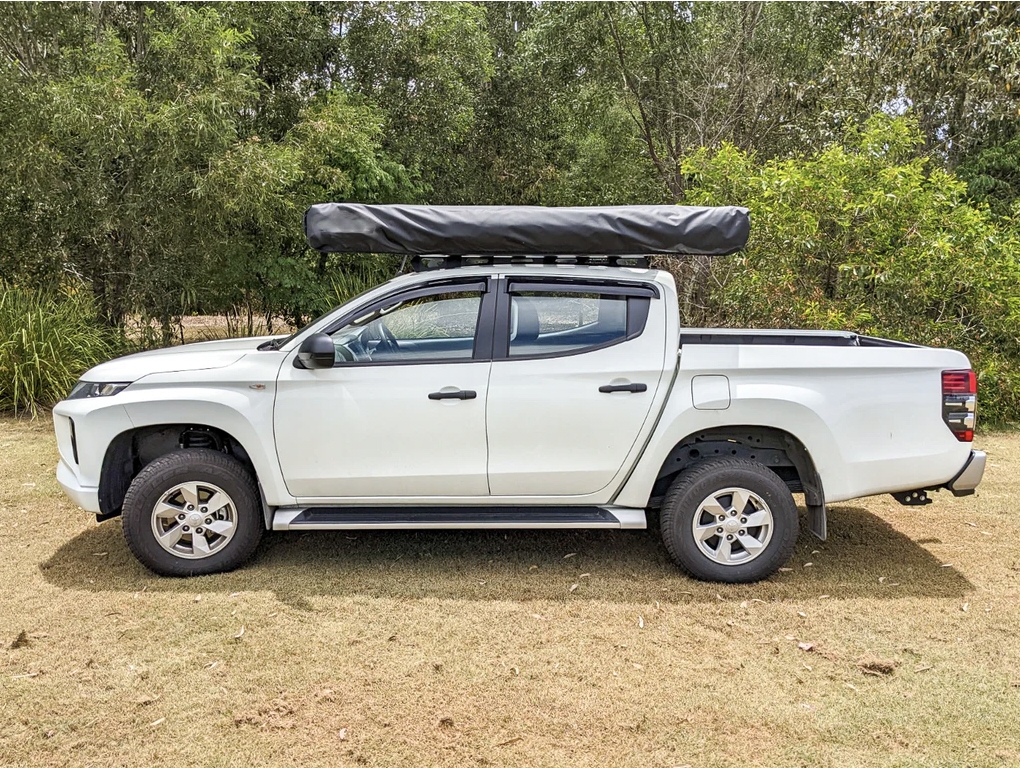
An awning is one of those upgrades that sounds simple until you start shopping. Then you hit three different styles, a fairly wide price spread, and a lot of strong opinions, and the simple purchase turns into a research project. Standard rectangle, 180 degree, or 270 degree: they all keep the rain off, so what actually separates them?
Quite a lot, as it turns out, and the right answer depends on how you camp, what you drive, and how much coverage you actually need. This is the straight comparison, built for Canadian conditions, so you can pick once and not regret it the first time the weather turns.
If you are setting up before the long weekends, this is the rain shield you will be glad you bought before June rather than during it.
The three styles, quickly
Before the detailed comparison, here is what each one is in plain terms.
A standard awning is a rectangular sheet that pulls out from one side of the vehicle, supported by legs. It covers a strip alongside the rig. Simple, affordable, and the lightest of the three.
A 180 degree awning wraps further around, covering roughly the side and part of the rear (or front) of the vehicle in a half-circle. It is the middle ground, more coverage than a standard, less bulk and cost than a 270.
A 270 degree awning sweeps in a large arc around most of one side and the back of the vehicle, creating a wide wraparound shelter with no centre pole in the covered area. It is the most coverage and the most premium of the three.
[DESIGNER: Three-panel overhead coverage diagram showing a top-down vehicle outline with the shaded coverage area for each awning type side by side (standard strip, 180 half-wrap, 270 wraparound arc). | Alt text: Overhead diagram comparing the coverage area of standard, 180 degree, and 270 degree overland awnings around a vehicle.]
Coverage area compared
Coverage is the headline difference and the main reason to step up in price. Here is how the three stack up across the things that matter most when you are choosing.
Wind and rain performance, the Canadian deciding factor
In a lot of climates, coverage is just about shade. In Canada, and on the coast especially, an awning earns its keep in weather, and that changes the calculation.
A 270 degree awning gives you the most protection from rain blowing in from changing directions, because it wraps around and shelters more of your living space no matter which way the system rolls through. With the optional walls or an annex room added, it becomes a genuinely weatherproof outdoor space, which is a real advantage during a wet BC weekend. The trade is that more fabric in the air means more sail area, so a 270 needs to be guyed out properly and brought in if the wind really picks up.
A standard awning has the least sail area and is the simplest to secure, but it only shelters one strip, so a shift in wind direction can leave you exposed. The 180 sits in between on both counts: more wraparound protection than a standard, less exposure to wind than a 270.
The honest takeaway for Canadian conditions: if you camp in shoulder seasons or anywhere the weather changes fast, the extra wraparound coverage of a 180 or 270 pays off more often than it does in dry, predictable climates. Just respect the wind with the bigger ones and stake them out properly.
Driver side vs passenger side mounting
This is the detail buyers overlook and then wish they had thought about. An awning mounts to one side of the vehicle, and which side matters more than it sounds.
The general logic is to mount the awning on the side you will set up your camp toward, away from traffic and toward your view or the door you use most. Many overlanders mount on the passenger side so the awning opens away from the road when parked, putting the sheltered space on the safer, quieter side. If your rooftop tent opens to a particular side, you usually want the awning on the same side so the two work together rather than fighting each other.
A 270 degree awning is also handed, it sweeps around either the driver or passenger rear, so you choose the version that matches your setup when you buy. Get this right at purchase and the whole camp flows. Get it wrong and you are working around it every trip.
Setup time
Counterintuitively, the biggest awning is often the fastest to deploy. A quality 270 is built to swing out and be usable in well under a minute, with guying out the only extra step for weather. A standard awning is also quick but involves setting legs. The 180 falls in the same fast range.
Setup time is rarely the deciding factor between these three, since all of them are far quicker than pitching a separate shelter. It matters most if you make a lot of short stops and want shade the moment you park, in which case the swing-out designs shine.
Best pairings: tent and awning combos
An awning is rarely bought alone. It works as a system with your rooftop tent, and the best combinations line up so the sheltered ground space sits right by the tent’s ladder and entry.
Standard awning plus a soft shell tent: a lean, budget-friendly combo for lighter use and simpler trips.
180 degree awning plus a hard or soft shell tent: the balanced setup most overlanders land on, good coverage without the top-tier cost or bulk.
270 degree awning plus a hard shell tent and an annex room: the full basecamp, maximum shelter for people who camp often and want a real outdoor living space in any weather.
The key in any pairing is matching the mount side to the tent’s opening so the awning shelters your entry and the space you actually use.
Price range in Canada
Price is the most-searched question on this topic, so here is the honest shape of it. Standard awnings are the entry point and the most affordable way to get covered. The 180 sits in the middle, a meaningful step up in coverage for a moderate increase in price. The 270 is the premium option, the highest cost of the three, justified by the wraparound coverage and the basecamp it creates when paired with walls or an annex.
The smart way to think about value: the awning is one of the cheaper pieces of a full overland setup relative to how much it improves daily life in camp. Most people who go a size up rarely regret it, while people who buy the cheapest one sometimes wish they had more coverage the first wet weekend. Buy for the conditions you actually camp in, not the ones in the photos.
Recommended picks by vehicle type
Common questions from Canadian buyers
Is a 270 degree awning worth the extra money?
For people who camp often or in changeable weather, usually yes. The wraparound coverage shelters far more of your space and turns into a weatherproof basecamp with walls added. For occasional, fair-weather use, a 180 or standard may be all you need.
Is an awning worth it at all?
If you spend any real time in camp, yes. An awning is the difference between hiding in the vehicle when it rains and having a usable outdoor space. It is one of the higher-value-per-dollar upgrades in an overland build.
Which side should I mount my awning on?
Generally the side you set up camp toward, away from traffic, and matching the side your rooftop tent opens to. Passenger side is a common choice so the awning opens away from the road. A 270 is handed, so pick the version that matches your setup.
Will a big awning handle Canadian wind?
With proper guying and staking, yes, but the larger the awning the more sail area it has, so a 270 needs to be secured well and brought in if the wind gets serious. A standard awning has the least sail area and is simplest in wind, at the cost of less coverage.
What is the difference between a 180 and a 270?
Coverage and price. A 180 wraps around the side and part of the rear in a half-circle. A 270 sweeps a full arc around most of one side and the back, giving more shelter for a higher cost and a bit more weight.
Can I add walls to make it weatherproof?
Yes, both 180 and 270 awnings typically accept walls or an annex room that close in the sheltered space into a more weatherproof outdoor room, which is a real advantage in wet BC conditions. This is part of what makes the larger awnings worth it for frequent campers.
Pick the coverage that matches your weather
There is no single best awning, only the right one for how and where you camp. Standard for budget and simplicity, 180 for the balance most overlanders want, 270 for maximum coverage and a true all-weather basecamp. Match the size to your vehicle, the mount side to your tent, and the coverage to the conditions you actually face, and you will buy once.
Kermode Overland carries 270 and 180 degree awnings, standard options, and the annex accessories that turn an awning into a weatherproof basecamp. If you want help matching the right awning to your rig and your rooftop tent before the season fills up, browse the lineup or reach out at kermodeoverland.com and get the rain shield sorted before June.